Monday, June 3, 2013

Occupy Wall Street: They're Back

from townhall.com


Katie Pavlich
Recommend this article 
If you were hoping the Occupy Wall Street movement was dead, you'll have to wait a little longer. The ACLU just filed a lawsuit on behalf of occupiers on Ohio. Their complaint? Their free speech rights were infringed upon because they weren't allowed to indefinitely camp in public places. More from Jason Hart:
The American Civil Liberties Union (ACLU) of Ohio has filed suit against the City of Columbus on behalf of Occupy Columbus, the socialist protesters who squatted on a sidewalk in front of the Ohio Statehouse in late 2011 and removed their frequently-vacant tent when the city tightened permitting rules last summer.

The local Occupy Wall Street group maintains that restricting use of tents and other structures in a public right-of-way infringes on speech and assembly rights protected in the First Amendment as well as in Article I of the Ohio Constitution.

Based on the complaint filed on May 30 in the U.S. District Court for the Southern District of Ohio, the Occupy Columbus case rests on the premise that placing a tent, table, or other structure that “is not easily movable” in public space amounts to protected speech.

“One of the defining physical features of the Occupy movement is the presence of its tent,” the complaint explains. “The tent is used to symbolize the ‘occupancy’ of public forums until the imbalance of powerin political and economic structures has been addressed.”
Apparently stinking up our public places wasn't enough for OWS, now they'll be stinking up our court systems too.

Friday, May 31, 2013

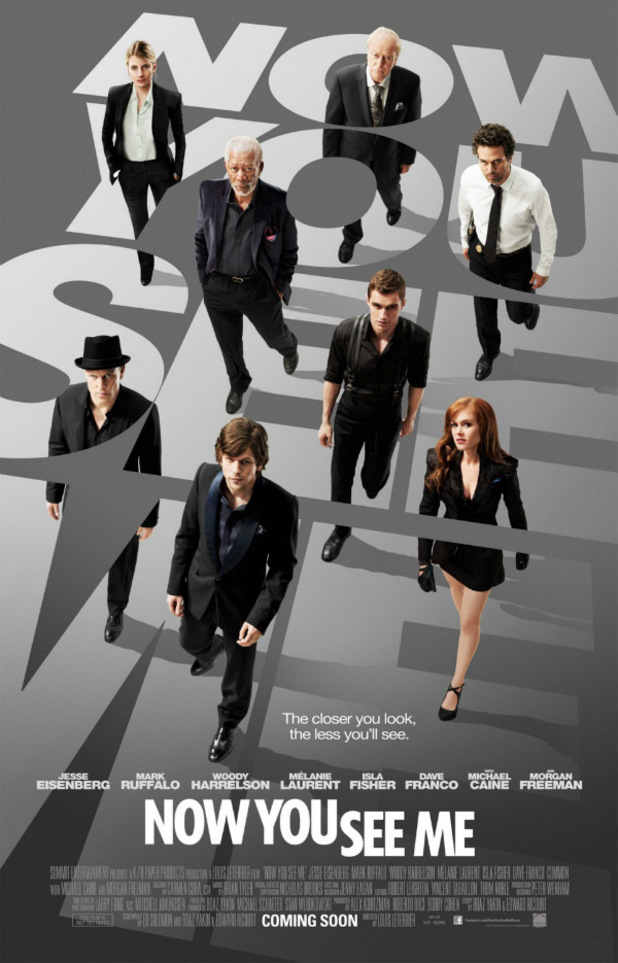
Mark Ruffalo: 'Now You See Me blurs line between good and evil'

from digitalspy


 |  By   |  


Mark Ruffalo has suggested that characters in his new film Now You See Me blur the line between good and evil.

Now You See Me stars Ruffalo as an FBI agent tasked with uncovering how a group of magicians were able to pull off a major bank heist in their stage act.
Mark Ruffalo as Bruce Banner in 'Avengers Assemble'
Mark Ruffalo in The Avengers


Ruffalo discussed the thriller with Flicks and Bits, and expressed his opinion that there is a kinship beween Now You See Me and the Occupy Wall Street movement.

"I got the script before Occupy Wall Street and that whole movement - which kind of captured the idea of social justice," he said. "But I think the theme is deeply embedded in contemporary culture and we were able to develop that into a modern Robin Hood tale with magicians stealing from the rich and giving back to the common man."

The actor continued: "It's a classic kind of heist movie, but it has this kind of Robin Hood, illusionist, 'good/bad' guys. It's got a great pulse, in that it moves quickly, it takes you to a lot of different places. There's fight scenes and chases and love scenes and humor and a really great, satisfying twist.

"And I really liked the massive undertaking of the script, the amount of planning that had to go into them and man hours that had to go into them to pull them off. It starts to become clear that they're not working on their own as the story goes forward."
'Now You See Me' poster


Ruffalo also discussed how the magicians' impressive illusions were filmed.

"I think the ratio of special effects to practical effects was about 50/50, it was pretty good - and it was fun to watch," he said.

"So much of what is in the movie was filmed live. A lot of the sleight of hand, a lot of the magic tricks, which was in camera. The magic tricks are actually designed to happen in front of the audience in the film just as they do for the audiences in the theatre. Anyway, aren't movies the ultimate magic trick?"

Now You See Me opens today (May 31) in the US and on July 3 in the UK. Watch a trailer below:


Read more: http://www.digitalspy.com/movies/news/a486230/mark-ruffalo-now-you-see-me-blurs-line-between-good-and-evil.html#ixzz2UtPpgVxB
Follow us: 
@digitalspy on Twitter | digitalspyuk on Facebook

Thursday, May 23, 2013

Occupy Arrests Near 8,000 As Wall Street Eludes Prosecution

from huffpost


The Huffington Post  |  Posted: 

Wednesday, May 22, 2013

Bankers go free while cops tase peaceful protesters and the Department of Justice targets journalists

from rollingstone

Are Homeowners Being Jailed for Demanding Wall Street Prosecutions?

Activists put up tents during a protest outside the U.S. Justice Department in Washington, D.C.
Alex Wong/Getty Images
May 22, 2013 3:00 PM ET
A two-day long housing protest outside the Department of Justice this week has resulted in nearly 30 arrests and several instances of law enforcement unnecessarily using tasers on activists, according to eye-witnesses. The action – which was organized by a coalition of housing advocacy groups, including the Home Defenders League and Occupy Our Homes – called for Attorney General Eric Holder to begin prosecutions against the bankers who created the foreclosure crisis.
"Everyone here is fed up with Holder acknowledging big banks did really bad stuff but [saying] they're too big to jail," says Greg Basta, deputy director of New York Communities for Change, who helped organize the event. Holder has previously suggested that prosecuting large banks would be difficult because it could destabilize the economy. The attorney general recently tried to walk those comments back – but the conspicuous lack of criminal prosecutions of bankers tells another story, one that Rolling Stone's Matt Taibbi has written about extensively.
Alexis Goldstein, a former Wall Street employee and current Occupy Wall Street activist who was also at the event on Monday, agrees. "I want Eric Holder to uphold the rule of law, regardless of how much power the criminal has," says Goldstein. She says the lack of criminal prosecutions has created a "culture of immunity" that only gets further entrenched by the small settlements that banks now consider a cost of doing business. "There's no risk," she says, adding that the DOJ is effectively "incentivizing breaking the law."
Around 400 homeowners and 100 supporters took part in Monday's actions outside the DOJ, according to Basta. One of them was Vera Johnson, of Seattle. "I've been dealing with foreclosure issues for three years," says Johnson, just minutes after being released from the jail where she was held for over 24 hours for participating in this peaceful protest. Bank of America recently granted Johnson a loan modification after the media picked up on a Change.org petition that she started to save her home; this reprieve turned out to be a time bomb, as her rates were set to return to their original levels after four years. It's an all too common story, and Johnson went to Washington, D.C. to "join in solidarity" with others in similar situations.
Many of this week's protesters have been black and Latino homeowners, who were hit particularly hard by the foreclosure crisis. Mildred Garrison-Obi – a black woman from Stone Mountain, Georgia – was evicted from her home in 2012, though with the help of Occupy Our Homes she was able to return to it after four months of facing homelessness. "It was devastating," says Garrison-Obi, who was arrested today in a related action held outside of a law firm where Holder was once a partner. "But I'm not alone."
Activists note with dismay that the government has been significantly harder on people who stage nonviolent demonstrations against Wall Street than it has on the crooked bankers responsible for the housing crisis. Goldstein and Basta both say they witnessed law enforcement using tasers on multiple protesters this week. Johnson says that several hours before her arrest, as she and others sat on planter boxes outside the DOJ, a Department of Homeland Security officer asked, "Do you want to get arrested?" and then, "Do you want to get tased?" Later, when she refused to unlock her arms with another protester after three warnings – hardly a violent act or a threat to public safety – she says she was tased from behind on her left arm. She turned around to see the same officer, who she recalls telling her, "That's what you get."
Carmen Pittman, an activist with Occupy Our Homes in Atlanta, suffered similar treatment at this week's protests. In video footage of her arrest, Pittman appears to have her arms interlocked with another protester.
Lawyers familiar with police codes of conduct note that this kind of passive resistance generally does not meet the official standards for when an officer can use a taser. "In a study of regulations around tasers, the National Institute of Justice found that most police departments do not allow taser use against someone who 'nonviolently refuses' a police command," says NYU law professor Sarah Knuckey, who co-authored a report on the suppression of the rights of Occupy activists. "The incident needs to be thoroughly investigated, there must be a public accounting of what happened and why, and any wrong-doing must be punished." 
Zach Lerner, another activist with NYCC, displayed marks left on his torso after a taser had been used on him.
A spokesperson for the Washington, D.C. police department directed requests for comment to the Federal Protective Service, part of the Department of Homeland Security. Scott McConnell, an FPS spokesperson, said that "a number of individuals" had "breached a security barricade after repeated warnings to leave the area" and that there had been 27 arrests as of Tuesday morning; he declined to comment on the video of Pittman getting tased or on FPS's taser policy generally.
Monday and Tuesday's actions came as the DOJ falls under increasing criticism for its investigations of journalists – first seizing records that cover dozens of Associated Press reporters, and now targeting Fox News' James Rosen. Many media observers have found the Rosen case especially troubling, due to the fact that he was investigated under the theory that he engaged in a conspiracy with Stephen Kim – his source – to leak government information. This is the same theory that U.S. officials have used to go after Wikileaks, and if applied more widely, it would effectively criminalize the basic act of investigative reporting. Some see the Obama DOJ's war on whistleblowers and leakers – and now journalists – less as a means of protecting national security than a way to crack down on who controls information.
As journalists start to get the feeling that their profession is under attack by Obama's DOJ, that department is saying something entirely different – though just as clearly – to the nation's financial elite. "The message," says Goldstein, "is that you can get away with anything."


Read more: http://www.rollingstone.com/politics/news/why-are-homeowners-being-jailed-for-demanding-wall-street-prosecutions-20130522#ixzz2U5Wg2Gub 
Follow us: @rollingstone on Twitter | RollingStone on Facebook

Cities erupt in youthquake: Millennials swell populations

from usatoday


The nation's big cities are riding out the first years of the post-downturn era with plenty of company — boosting their population via a youth movement.
Census Bureau data released Thursday show that 48 of the 50 most populous U.S. cities have grown since 2010, compared with only 40 of the top 50 in the first two years after the 2000 Census. Of the top 100, 93 have grown since 2010, compared with just 72 a decade ago.
Many of the biggest — New York, Houston, Phoenix, San Antonio, San Diego and Dallas, among others — are outpacing the nation's 1.7% growth rate since 2010.
"Urban America is recovering faster than more remote, more rural places," said Robert Lang, a professor of urban affairs at the University of Nevada-Las Vegas.
Lang said urban areas appeal to Millennials (those born from about 1982 to 2001) "in part because they haven't seen cities in crisis. They missed the riots of the 1960s, the urban decline of the 1970s and the crack epidemic of the 1980s. "If you're a kid born in 1993 or 1992 and you're in college now, you're looking around the country thinking about where you want to move ... you've seen fairly ... tranquil cities, in relative terms to what their history was."
Only two big cities — Detroit and Cleveland — lost population between 2010 and 2012, according to the population estimates from July 1, 2012.
The urban resurgence is led by mid-sized cities including Austin and Fort Worth and Charlotte. Austin grew 6.6% in two years, leapfrogging Jacksonville, Indianapolis and San Francisco to become the USA's 11th-largest city. In 2000, it was No. 17.
Other trends:
• New York City, by far the USA's most populous city, grew 2%, adding about 161,500 residents since 2010. Since 2000, about 328,000 more people have called themselves New Yorkers, a group bigger than the entire population of St. Louis;
•New Orleans continues to recover from Hurricane Katrina in 2005, growing 7.4% since 2010 to top 369,000 — more than 80% of its pre-Katrina population but shy of its Census 2000 population of 485,000.
• Government budget crunches have put state capitals in a bind: Nine have shrunk since 2010; half are lagging the growth rate of their regions.
Perhaps the biggest exception to the capital crunch is Austin, which has grown more than 26% since 2000. Brookings Institution demographer William Frey says Austin enjoys a "trifecta" of qualities that make it attractive: It's hip, it's a high-tech city with a flagship state university, and it's in Texas, a magnet for newcomers. "In some ways it's a prototype of what other cities would like to become," he says.
"Our city is strong, getting stronger every day," says Austin Mayor Lee Leffingwell. "Our growth and economic success are not accidental."
Frey notes that Charlotte, which grew 5.4% since 2010 has grown into a high-tech and financial center whose industries do business not just with those in other U.S. cities but with the rest of the world.
Many cities actually grew faster in 2012 than in 2011, even as the housing crisis eased and city dwellers had a chance to move to the suburbs, Frey says. Those who were forced to stay put during the recession because of troubled mortgages or joblosses may be "taking a second look" at cities.
Also a new generation of young urbanites may be less willing to move to the suburbs, even as their kids enter school. "I think the jury is still out a little bit as to whether that's going to ease up when the housing market gets better," Frey said. As the recession recedes further, he said, "they may follow in the footsteps of many generations before them out to the suburbs."
But Kenneth M. Johnson, senior demographer at the University of New Hampshire's Carsey Institute, says that as young city dwellers enter their 30s and 40s, a shortage of high-quality public schools could be "a deal breaker."
"It's going to take a little bit more than a couple of years of growth for the cities to convince me that there's some generational change going on," he said. "Maybe this generation is more attracted to the cities than the last two or three generations have been. I think it's too early to tell."

Tuesday, May 21, 2013

Occupy Our Homes Activists Arrested At Justice Department Headquarters

from firedoglake.com


By:  Tuesday May 21, 2013 11:14 am


Members of one of Occupy Wall Street’s offshoots, Occupy Our Homes, were arrested Monday and Tuesday demonstrating outside the headquarters of the Department of Justice in Washington.
According to Washington police the protesters attempted to enter the building.
About 100 protesters with groups called the Home Defenders League and Occupy Our Homes marched on the building about 2 p.m. Some set up tents on the lawn and sidewalk while others ran up to the building’s Constitution Avenue entrance.
According to D.C. police, 17 people were arrested. Ann C. Wilcox, an attorney who represents protesters, said several were tased during the scuffle. A D.C. police spokeswoman said D.C. police were not involved in the tasing. Federal law enforcement officials on the scene declined comment.
During the arrest tasers were used on protester Carmen Pittman who was arrested outside the Department of Justice.
Part of the reason for the protest at DOJ, according to activists, is to demonstrate strong opposition tocomments Attorney General Eric Holder made regarding his inability to prosecute Wall Street banks due to the risks such a prosecution brings to the financial system. These statements were later characterized as Holder in effect saying some banks were Too Big To Jail and therefore corruption by Wall Street wouldcontinue indefinitely with the tacit sanction of the government.
Occupiers also cited the unjust fraudulent foreclosure settlement and continual foreclosures as grievances that led to the protest. The miniscule amount of money the banks paid is not only seen as comically inefficient at making victims whole but extremely ineffective in deterring future crimes. The banks escaped justice thanks to the Justice Department.
The Occupy Our Homes protest at DOJ is part of the Wall Street Accountability Week of Action.