Friday, August 10, 2012

The Screwed Election: Wall Street Can’t Lose, and America Can’t Win

Everyone hates the big banks—except the two candidates running for president. Joel Kotkin on the bipartisan triumph of crony capitalism.

Everyone hates Wall Street.
Occupy Wall Street
Occupy Wall Street demonstrators stand and cheer in front of the George Washington statue on Wall Street as they celebrate the protest's sixth month on March 17, 2012. (John Minchillo / AP Photo)
About two in three Americans do not think what’s good for Wall Street is good for America, according to the 2012 Harris poll, but do think people who work there are less “honest and moral than other people,” and don’t “deserve to make the kind of money they earn.” Confidence in banks is at a record low, according to Gallup, as they’ve suffered the steepest fall in esteem of any American institution over the past decade. And people have put their money where their mouth is, with $171 billion leaving the stock market last year alone, and 80 percent of Wall Street communications executives conceded that public perception of their firms was not good.
Americans are angry at the big-time bankers and brokers, and yet, far from a populist attack on crony capitalism, Wall Street is sitting pretty, looking ahead to a presidential election that it can’t possibly lose. They have bankrolled a nifty choice between President Obama, the largest beneficiary of financial-industry backing in history and Mitt Romney, one of their very own.
One is to the manner born, the other a crafty servant; neither will take on the power.
Think of this: despite taking office in the midst of a massive financial meltdown, Obama’s administration has not prosecuted a single heavy-hitter among those responsible for the financial crisis. To the contrary, he’s staffed his team with big bankers and their allies. Under the Bush-Obama bailouts the big financial institutions have feasted like pigs at the trough, with the six largest banks borrowing almost a half trillion dollars from uncle Ben Bernanke’s printing press. In 2013 the top four banks controlled more than 40 percent of the credit markets in the top 10 states—up by 10 percentage points from 2009 and roughly twice their share in 2000. Meantime, small banks, usually the ones serving Main Street businesses, have taken the hit along with the rest of us with more than 300 folding since the passage of Dodd-Frank, the industry-approved bill to “reform” the industry.
Yet past the occasional election-year bout of symbolic class warfare, the oligarchs have little to fear from an Obama victory.
Dan Gross discusses Knight Capital's $440 million loss
“Too big to fail,” enshrined in the Dodd-Frank bill, enjoys the full and enthusiastic support of the administration. Obama’s financial tsar on the GM bailout, Steven Rattner, took to The New York Times to stress that Obamians see nothing systemically wrong with the banking system we have now, blaming the 2008 market meltdown on “old-fashioned poor management.”
As anger at the banks builds, Republicans nominate a Wall Street patrician whose idea of populism seems to be donning a well-pressed pair of jeans and a work shirt.
“In a world of behemoth banks,” he explained to we mere mortals, “it is wrong to think we can shrink ours to a size that eliminates the ‘too big to fail’ problem without emasculating one of our most successful industries.”
But consider the messenger. Rattner, while denying wrongdoing, paid $6.2 million and accepted a two-year ban on associating with any investment adviser or broker-dealer to settle with the SEC over the agency’s claims that he had played a role in a pay-to-play scheme involving a $50,000 contribution to the now-jailed politician who controlled New York State’s $125 billion pension fund. He’s also expressed unlimited admiration for the Chinese economic system, the largest expression of crony capitalism in history. Expect Rattner to be on hand in September, when Democrats gather in Charlotte, the nation’s second-largest banking city, inside the Bank of America Stadium to formally nominate Obama for a second term.
In a sane world, one would expect Republicans to run against this consolidation of power, that has taxpayers propping up banks that invest vast amounts in backing the campaigns of the lawmakers who levy those taxes. The party would appeal to grassroots capitalists, investors, small banks and their customers who feel excluded from the Washington-sanctioned insiders' game. The popular appeal is there. The Tea Party, of course, began as a response against TARP.
Instead, the party nominated a Wall Street patrician, Mitt Romney, whose idea of populism seems to be donning a well-pressed pair of jeans and a work shirt.
Romney himself is so clueless as to be touting his strong fund-raising with big finance. His top contributors list reads something like a rogue’s gallery from the 2008 crash: Goldman Sachs, JPMorgan Chase, Morgan Stanley, Credit Suisse, Citicorp, and Barclays. If Obama’s Hollywood friends wanted to find a perfect candidate to play the role of out-of-touch-Wall Street grandee, they could do worse than casting Mitt.
With Romney to work with, David Axelrod’s dog could design the ads right now.
True, some of the finance titans who thought Obama nifty back in 2008 have had their delicate psyches ruffled by the president’s election-year attacks on the “one percent.” But the “progressives,” now tethered to Obama’s chain, are deluding themselves if they think the president’s neo-populist rancor means much of anything. They get to serve as what the Old Bosheviks would have called  “useful idiots,” pawns in the fight between one group of oligopolists and another.
This division can be seen in the financial community as well. For the most part Obama has maintained the loyalty of those financiers, like Rattner, who seek out pension funds to finance their business. Those who underwrite and speculate on public debt have reason to embrace Washington’s free spenders. They are also cozy to financiers like John Corzine, the former Goldman Sachs CEO and governor of New Jersey, whose now-disgraced investment company MF Global is represented by Attorney General Eric Holder’s old firm. 
The big-government wing of the financial elite remains firmly in Obama’s corner, as his bundlers (including Corzine) have already collected close to $20 million from financial interests for the president. Record support has also poured in from Silicon Valley, which has become ever more like a hip Wall Street west. Like its east-coast brethren, Silicon Valley has also increased its dependence on government policy, as well-connected venture capitalists and many in the tech community  have sought to enrich themselves on the administration’s “green” energy schemes.
Romney, on the other hand, has done very well with capital tied to the energy industry, and others who invest in the broad private sector, where government interventions are more often a complication than a means to a fast buck. His broad base of financial support reflects how relatively few businesses have benefited from the current regime.
Who loses in this battle of the oligarchs? Everyone who depends on the markets to accurately give information, and to provide fundamental services, like fairly priced credit.
And who wins? The politically well-situated, who can profit from credit and regulatory policies whether those are implemented by  Republicans or Democrats.
American democracy and the prosperity needed to sustain it are both diminished when Wall Street, the great engineer of the 2008 crash, is all but assured of victory in November.

Tuesday, July 31, 2012

Why Occupy Wall Street Isn't Working


Posted: 07/31/2012 9:10 am

On September 17, 2011, over one thousand protesters moved into Zuccotti Park, located in New York's financial district. This marked the start of a movement that would soon gain international attention: Occupy Wall Street. The idea for a peaceful protest on Wall Street, ironically, did not emerge from the United States but instead from a Canadian-based group known as the Adbusters. After spreading to the United States, the protesters embraced the slogan "We are the 99 percent," which implies that the United States is now controlled by a one percent elite group who have an immense amount of social, economic and political influences. The slogan emphasizes the extreme wealth disparity that is present today, but also highlights various other issues in the United States economy and society, such as the limited social mobility and lack of opportunity. The reasons and concerns brought up by the Occupy Wall Street movement are justified because of the growing economic and social inequality; however, although the movement has significantly increased awareness about the economic disparity and the unbalanced power in the hands of the wealthy, the movement has ultimately failed to produce tangible reform or make a positive impact because of the lack of leadership and inefficient protest methods.
Some people might praise the movement for launching itself into a new era with different and more technology-oriented protest methods, making it more innovative and effective protest. With Internet and technology revolutionizing the world, people believe that the Occupy Wall Street protesters are taking a step in the right direction and creating an Internet-based movement where most of the discussion and planning is done over Internet in a collaborative fashion. As Stephen Gandel states, people have "tweeted, Tumblred and streamed" in order to get the work out about Occupy Wall Street; most of the Occupiers heavily rely on "social media to get their message to friends and the rest of the world." What people fail to realize is that having an Internet-based movement actually takes away the impact and the ability to facilitate change and make a difference -- relying on the Internet vastly limits the efficiency and efficaciousness of the protests. Because so much of the movement is influenced by the events and comments online, the demographic of the audience is immediately confined to a younger generation. Instead of appealing to a variety of people of different ages, most of the protesters are relatively young because those are the people who use social networking sites the most.

The Occupy protesters have also been threatening the livelihoods of many people who are not part of the protest, which can be clearly seen in Zuccotti Park, the symbolic base of the movement. Because there is so much press about the protesters occupying Zuccotti Park, many potential customers are being scared away from the small businesses that surround the area. According to Connor Sheet's article in the International Business Times, 12 business owners report that they have been losing $9,000 per day since the Occupy Wall Street movement first started in September; by mid-November, the businesses reported that "$479,000 has been lost due to the impacts of the Occupy Wall Street protest encampment in Manhattan's financial district." Many people cannot easily access these businesses anymore because of the police enforcement in the local area; because of the decrease in revenue, many of these businesses have had to lay off a number of employees due to restricted access and fewer customers. The Occupy protesters are directly and negatively impacting the small business owners and their employees, who are the same people that they should be fighting for.
Occupy Wall Street brings many important and legitimate concerns about the future of America, such as the growing wealth disparity, lack of job opportunity and social mobility, and lack of response from the government. The issues they raise are essential to the well-being of the United States, but the protest methods have neither been beneficial or impactful. Though Occupy Wall Street aims to better the conditions for the 99 percent, because of their lack of leadership and dependency on the Internet, they do not have a positive influence. The protesting methods that the protesters have been employing are more detrimental for the 99 percent than for the one percent, making the movement ineffective as a whole.
Share your reports & photos from Occupy Wall Street events
If you've been to an Occupy Wall Street event anywhere in the country, we'd like to hear from you. Send OfftheBus your photos, links to videos or first-hand accounts of what you've seen for possible inclusion in The Huffington Posts's coverage.

Sunday, July 29, 2012

'Dark Knight Rises' Connection To Occupy Wall Street Was 'Luck'


'We couldn't have planned that. It just sort of happened,' writer David S. Goyer says of the parallel between the movie and today's politics.


When people talk about Christopher Nolan's Batman trilogy, it is usually not in the context of a superhero movie. In the seven years since "Batman Begins" redefined the character's cinematic persona, the series has entered into a realm of its own, one based on gritty realism and weightier consequences.
MTV News spoke with two of the series' writers, Jonathan Nolan and David S. Goyer, at the red-carpet premiere of "The Dark Knight Rises" to find out what made these movies stand out in the genre of costumed heroes.
Nolan said that much of the difference came down to the nature of the man behind the mask, Bruce Wayne. "The thing about Bruce Wayne is that his superpower is money and rage," he said. "And there's something transformative about a normal person, not a guy who was born with some magical gift that he just discovers, but a person who decides to become something extraordinary."

'Dark Knight Rises' Writer Inspired By Frank Miller's 'Batman'

It was that choice that had an effect on Nolan at a young age. "I think I always related to that. It's always been the key difference between a character like Batman and all the other characters in the DC pantheon," he said. "There are some great characters there, but this is the one I always kind of connected to the most. ... You had all kinds of science fiction and some fantasy throughout the Batman books through 70 years, but for the most part, we took the idea that this was a real guy in the real world and ran in that direction."
David S. Goyer, who co-wrote the screenplay for "Batman Begins" and the stories for "The Dark Knight" and "The Dark Knight Rises," brought up some similar reasoning, but it was also important to make the hero relevant to today.
"Batman has always been the most grounded of the major superheroes," Goyer said. "He doesn't have any superpower, doesn't come from an alien planet, things like that, but our approach from the very beginning was that we were going to treat this as real-world as possible within the superhero confines."
Many have pointed out an apparent parallel between the story of "The Dark Knight Rises" and the Occupy Wall Street Movement, but Goyer dismissed any similarities as coincidence. "It was just kind of luck that the themes we were dealing with in this film happened to coincide with the Occupy Wall Street, 99 percent thing," he said. "We couldn't have planned that. It just sort of happened. We try to make them as meaningful. Hopefully, they're sort of like a Greek myth that reflects back on what's happening in today's politics."
Check out everything we've got on "The Dark Knight Rises."
For breaking news and previews of the latest comic book movies — updated around the clock — visit SplashPage.MTV.com.

'Dark Knight Rises' Ending Had Goyer Tearing Up

Friday, July 27, 2012

Steve Scauzillo: Occupy is 'Bane' of new Batman movie


FRIENDS and countrymen:
I have not come here to bury the Occupy Movement, but to praise it.
That quote, loosely adapted from Shakespeare's "Julius Caesar," is not true for the movie "The Dark Knight Rises."
The latest Batman installment, third in a trilogy of meatier super hero movies based on "the Batman" comic book character by director and screenwriter Christopher Nolan, has strong allusions to the Occupy Wall Street Movement. It pokes and prods the rich, or in the Occupy vernacular, the 1 percent, in not-so-subtle ways.
It puts the Occupy message into the mouth of the evil villain - Bane. Seems like this movie's more damaging to the left than to the right. (Some have said it was a dis on Bain Capital, a company once run by Mitt Romney.)
The movie's antagonist, an exile turned away by the League of Shadows (see the first Nolan movie, "Batman Begins," 2005) puts capitalism in his bull's-eye and literally occupies Wall Street and New York, er, Gotham City. There are speeches made by the evil Bane talking about removing wealthy and corrupt leaders and giving "the people" their rightful power.
One scene shows a Batmobile-type hovercraft zipping down a Manhattan street, past a shot of a Saks Fifth Avenue store as the city is occupied. Even more blatant, there's a scene in which a rich man is hiding under a piece of Rococo furniture in what presumably is a high-rise apartment, only to be dragged away by one of the 99

Advertisement

percent now running Gotham with Bane.When I saw the movie, I was reminded of my last trip to New York City in October, when Occupy Wall Street was rallying in a small city park nearby.
I stood a good 500 yards from the capital of Western wealth. Police barricades blocked the entrance to the New York Stock Exchange Building to all but traders and office workers. Later, NYPD officers wearing crisp blue uniforms patrolled the streets, some on horseback, swarming Lower Manhattan in anticipation of the anti-movement's next strike. But nothing happened, at least not that day. And I still don't recall any daggers being thrust into the heart of capitalism by the fledgling group.
As an aside, a device made popular in Shakespeare tragedies, Wall Street didn't need any Bane or Occupiers to toss monkey wrenches into the economy. It managed to mess things up on its own through greedy brokers and dishonest trading based on faulty mortgages and a pyramid scheme involving credit default swaps. But that, as they say, is history.
My point is this movie - a reminder that it is just that - doesn't pay homage to Occupy. It shatters it. It directly lifts themes and some language and puts them in the mouth of an evil terrorist who loses credibility with his twisted plan to kill innocent people.
Yes, I know, that's entertainment. But why aren't I hearing more outrage from the Occupy Movement about this? The group is clearly cast in this unflattering light. To tell you how unflattering will reveal too much of the plot and I don't want to be a spoiler for those who haven't seen it yet.
Even though Nolan and others who made the movie say they didn't base the character or the plot on the Occupy movement, that's not the point. Even if it was not intentional, the perception is there. And perception is what sways public opinion. That can't be good for a movement that just got into trouble for drawing on the sidewalk in L.A with chalk.
Unless the folks from Occupy adhere to that old Hollywood adage: There's no such thing as bad publicity.
Steve.scauzillo@sgvn.com
626-962-8811 ext. 2237


Read more:http://www.sgvtribune.com/opinions/ci_21171416/steve-scauzillo-occupy-is-bane-new-batman-movie#ixzz21r1g8HNQ

Thursday, July 26, 2012

Hardworking Americans should not be living in poverty


By Mary Kay Henry and Christine L. Owens, Special to CNN
updated 10:15 AM EDT, Wed July 25, 2012
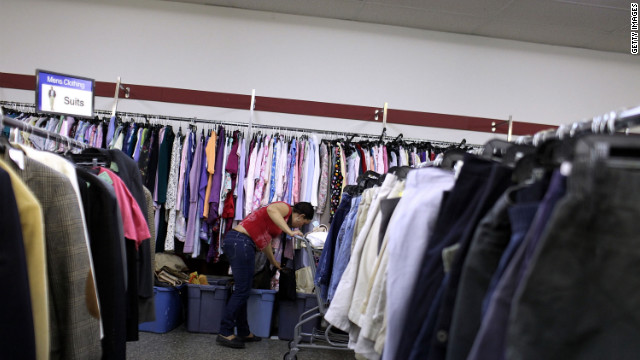
A woman shops at a Salvation Army thrift store recently in Utica, New York.
STORY HIGHLIGHTS
  • Writers: Working at minimum wage, Americans can't keep families fed and clothed
  • As prices rise, they say, federal minimum wage stays at $7.25 an hour, or $15,080 a year
  • Writers: As CEOs, corporations profit, middle-class jobs lost to low-wage work
  • Writers: Minimum wage hike would help struggling Americans
Editor's note: Mary Kay Henry is international president of the Service Employees International Union. Christine L. Owens is the executive director of the National Employment Law Project.
(CNN) -- When the U.S. economy collapsed, millions of us lost our homes, our jobs, our retirement savings and our faith in the American dream. What we gained was a very clear view of the vast -- and growing -- divide between the rich and the rest of us.
Like many hardworking Americans earning minimum wage, Margaret Lewis knows firsthand what it's like to live on the edge. She works as a transporter for passengers with disabilities at O'Hare International Airport. She wakes up at 1 a.m. to go to work, and spends the early morning hours pushing wheelchairs to gates and helping travelers on and off planes.
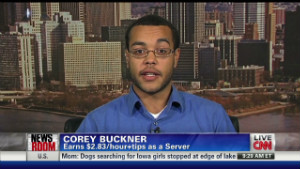
With tips, and Illinois' minimum wage -- which is $1 above the federal minimum wage of $7.25 an hour -- Margaret makes about $18,000 a year, or $10,000 below the federal poverty limit for a household of five.
Margaret lives with her four school-age children in a three-bedroom apartment on Chicago's South Side. Two recent shootings on her block make her fear for her children's safety, but she cannot afford to move. Margaret is unable to pay the $850 per month rent, so she and her family perform janitorial tasks for the landlord to make ends meet. The children's clothing is all secondhand, Margaret uses food stamps to make sure everyone is fed and when it is time to buy shoes for school, she has to save an entire paycheck.
Mary Kay Henry
Mary Kay Henry
Christine L. Owens
Christine L. Owens
Tuesday marked the third anniversary of the last increase in the federal minimum wage. For the last three years, while the prices of gas and milk have risen steadily and the richest 1% have enjoyed huge tax breaks, the federal minimum wage has remained frozen at $7.25 an hour, which amounts to just $15,080 a year -- as long as you get paid for any time you take off. That's more than$7,000 below the federal poverty line for a family of four.As a result, the purchasing power of the minimum wage has slowly eroded -- in just three years, its real value has sunk to $6.77 per hour, a nearly 50-cent drop.
The Bush tax cuts, which are simply the perquisite of the moment for the 1%, allow for the richest to prosper at the expense of middle-class and low-income workers. While CEOs make millions and their corporations make billions as part of a so-called economic recovery, the majority of Americans are struggling to make ends meet. This struggle is exacerbated by the low federal minimum wage. Asmiddle-class jobs are increasingly replaced by low-wage work, however, this is the economic reality for a growing number of Americans.
Unless Congress raises the federal minimum wage, economic security for workers in low-wage jobs, the fastest-growing sector, will disappear. It is incumbent on members of Congress to raise the federal minimum wage and index it to inflation, putting more money into the pockets of ordinary Americans to boost our economy and aid a real, long-term recovery.
The Rebuild America Act has been introduced in both the House and the Senate to do just that, while also raising the federal minimum wage for tipped workers, which has been a meager $2.13 since 1991. The Fair Minimum Wage Act, not yet introduced, is also a call for a more decent wage. Support for these bills is support for an economic recovery that extends to all Americans.
Group pushes minimum wage raise
This legislation could make a difference for Bruce Gross, a father of three in Baltimore. He worked as a sandblaster, supporting his wife, their twin boys, daughter and two nephews, until the economy crashed. Now, Bruce makes $7.36 an hour as a telemarketer.
Bruce's wife is sick and unable to work, leaving him as the sole breadwinner. Bruce estimates he brings home about $200 every other week and his bills are more than double that. Bruce and his family recently sat in the dark for a few days because he had to choose between paying his electric bill and buying groceries.
When things got really rough, Bruce asked neighbors if they could spare a few slices of bread and some cheese for sandwiches. He is heartbroken that he is unable to provide even basic necessities, like food and school supplies, for his children.
People who work for a living should be able to make a living from their work. Low-wage workers should not have to scrape by, while many of the companies they work for are making more money now than they were three years ago. The federal minimum wage hasn't kept up with inflation, but CEO pay has risen 725% over the last 30 years and 80% of all real income growth has gone to the richest 1% of Americans.
The real value of the minimum wage peaked in 1968. Had it kept pace with rising living costs, the minimum wage would exceed $10.50 per hour today. Meanwhile, the U.S. economy has been reorganizing over the past 30 years away from middle-wage jobs in manufacturing and construction and toward low-paying jobs in the rapidly expanding service, retail and restaurant industries.
We have little reason to expect large corporations that are the principal employers of low-wage workers to voluntarily offer higher pay; rock bottom wages are a core profit-making strategy for retail giants and fast food chains. Nor does reality match the myth that prosperity at the top will eventually "trickle down" to workers at the bottom: corporate profits are at their highest level as a share of GDP, and wages at their lowest, since the 1950s.
Neither facts nor common sense support a federal minimum wage stuck at $7.25. It wasn't low-wage workers who crashed the economy. It was not a raise for these workers, but rather an unquenchable thirst for profit, that led to Wall Street's disastrous game of financial Russian roulette. Why, then, should low-wage workers pay the price?
How high must profits go before a modest wage increase isn't raised as a specter of impending corporate doom? It's easy to exploit such fears in this economic climate, but these tired old canards -- trotted out in every minimum wage fight -- are just an excuse for political inaction and continued corporate greed.
The bottom line is that people who work for a living put their money right back into our economy. What business in this country needs right now is customers and too many hardworking Americans aren't making enough money to get by. If we raise the federal minimum wage and demand the 1% pay their fair share to reduce income inequality, we will boost our economy, help small business grow and create jobs.
Follow us on Twitter @CNNOpinion.
Join us on Facebook/CNNOpinion.