Tim Pool is a marked man. He knew it when he arrived to Washington Square Sunday night. Before the evening was through, the 25-year-old known for documenting
Occupy Wall Street became a story himself.
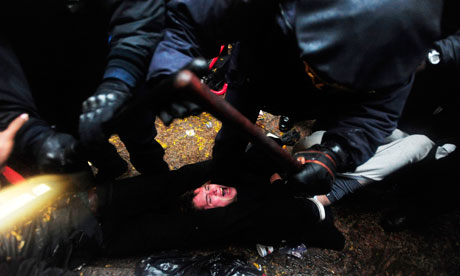
Following a raucous march through lower Manhattan, hundreds of Occupy demonstrators made their way to an abandoned community centre. Pool was live-streaming the procession when a masked man took it upon himself to stop him. Pool was struck in the arm and a scuffle ensued. The melee of screaming people and thrashing bodies looked like your standard police-on-protester skirmish, except in this case the participants were seemingly all activists, ostensibly drawn to the demonstration for the same basic reasons.
Oakland protesters were clearly prepared for a confrontation and carried homemade shields and rolling barricades. Demonstrators threw canisters back at the police along with rocks and other projectiles. At one point a crowd of protesters reportedly knocked down a fence, allowing a crowd that faced a possible mass teargassing to escape. In the evening protesters entered Oakland's City Hall, removed an American flag and set it on fire.
Responding to the arrests in Oakland,
Occupy protesters in New York City took to the streets. As they marched, and occasionally sprinted, through lower Manhattan, masked protesters were seen pulling debris into the road. A small minority of demonstrators threw bottles at police officers, while larger numbers chose to berate the cops with chants of "fuck the police" and "racist, sexist, anti-gay/NYPD go away." The combative attitude and aggressive tactics, justified by some by ongoing police violence, upset a number of demonstrators.
It is clear that Occupy isn't going away. What remains to be seen, is the shape the movement will take in the coming months.
Tim Pool is as ubiquitous in the Occupy Wall Street protest scene as he is controversial. He describes himself as both an activist and a journalist. Chances are if there's an Occupy-related action in
New York, Pool is in the area, narrating what's happening into his iPhone.
His coverage of Occupy protests has garnered him attention from Time magazine and attracted over 11,000 followers to
his Twitter feed. He's also raised over $15,000 private donations to continue his work. Pool earned much his fame following his non-stop 21-hour coverage of Occupy Wall Street's eviction from Zuccotti Park in mid-November.
It was that night Pool's less laudatory reputation also began to take shape.
Pool says that at approximately 2am he happened upon a number of masked protesters releasing the air from a police cruiser's tires. Pool claims he had no intention of filming the incident initially, but was quickly confronted nonetheless.
The activists demanded he stop filming, and he refused. With al-Jazeera tapping into his live stream and thousands of viewers relying on him to capture the action, Pool defended his right to relay what was going on in front of him, regardless of what it depicted. It's a position he's stood by ever since.
"When you have anarchists draining police tyres who are saying don't film me because I'm doing something illegal, I'm going to film them," Pool said on Sunday night. Pool has no qualms about filming protesters engaged in illegal activities and knows full well that his broadcasts are available for the police to monitor.
The way he sees it, disabling police vehicles and throwing bottles at the cops puts less confrontational demonstrators at risk. "They are opening the door for police to start beating and arresting innocent people."
Pool's commitment to full disclosure, as well as his semi-celebrity status, has made him an divisive figure within the Occupy movement. While some see him as a champion of radical transparency, others describe him as a snitch.
Protester Jason Ahmadi says he confronted Pool about his work at an Occupy-related movie premiere last month. Ahmadi claims he asked Pool if he realised he was consistently, "informing the police on a live basis what is going on and what activities are happening." According to Ahmadi, Pool said yes and defended his right to continue doing so.
"That in my mind, is informing the police. And when you inform the police of an illegal activity, that is the definition of a snitch. Whether he's getting paid for it or not, it still meets the definition of the term," Ahmadi said.
Pool misunderstands the nature of the police, Ahmadi contends. "A lot of people haven't really been in these situations for a long time and are kind of new to the whole protest scene and actually still kind of believe that police are here to protect us and the police are here to allow us to continue to protest peacefully."
"They don't actually see that the police is the oppressive arm of the state, that shuts down freedom of speech, arrests peaceful protesters and beats peaceful protesters, criminalizes the homeless, beats up and criminalizes people of color," he added. "I don't think he's fully conscious of what he's doing."
Ahmadi suggested Pool's record with the cops might also be a reason for concern. "Almost every single live-streamer has been arrested. Almost every single live-streamer has been targeted by the police and nabbed while they were doing their work … Tim Pool has never been arrested."
Pool told the Guardian he has never been asked to help the police in any way and says he is not a police officer.
Late last Saturday Pool noted a series of "indirect threats" on Twitter suggesting people were looking to disrupt his Occupy coverage. By the time Sunday's demonstration rolled around Pool said people were warning him face to face.
"When I was actually at Washington Square someone came up to me and said that they had heard there was going to be potential black bloc used and they said 'We got your back.'" he said. Pool claims another person later approached him and said 'We had heard about some threats so we're going to have so-and-so keep a tail on you to make sure that you're all right."
Premeditated or not, the incident has caused a stir among the New York City Occupy crowd.
Protester Ted Hall says the controversy surrounding Pool speaks to larger issues within Occupy Wall Street's direct action working group, the collective responsible for organising many of the movement's demonstrations.
"There's this militant animosity that's now being bred by DA [direct action], being condoned and secretly cultivated by DA," Hall told the Guardian.
Hall believes Pool is helping Occupy face facts: "We have people within our movement who are doing things that the vast majority of people in this movement would not agree with. The vast majority of us are not going to agree that releasing the air out of the tires of the cops is going to do anything but agitate them, and they have guns."
Occupy should focus its energy on playful, creative actions planned and executed with transparency, Hall contends. "We're not going to win this by trying to show our teeth. We're like a teeny-tiny creature in this crazy ecosystem of oppression. We have to be really, really smart."
"Our strengths are not in secrecy. Our strengths are in transparency," he adds. "Anything that's secretive is going to attract instigators and undercovers like a moth to a flame."
The increased militancy Hall refers to can be traced, in part, to Occupy Wall Street's
support of a so-called "diversity of tactics." Contrary to popular belief, the New York City branch of the movement is not non-violent in an official sense. Proponents of the diversity of tactics philosophy argue that it frees a movement to respond to repression with the most effective strategies available.
"What we do is we endorse non-violent direct action," says Occupy Wall Street organiser Patrick Bruner. By supporting a diversity of tactics the movement allows itself a substantial amount of flexibility in what it condemns and condones. Ostensibly, diversity of tactics is supposed to be exactly what it says: a range of options. It appears to have been interpreted by some, however, as coded language for property destruction and violence. While the movement has been overwhelmingly peaceful – even in the face of heavy-handed police crackdowns – diversity of tactics indeed keeps the option of other avenues open.
As police and protesters continue to clash in the streets, more confrontational strategies are beginning emerge. "It's natural that new tactics of resistance would be used," Bruner explained.
In many cases these tactics are unlawful. Taking part in them invites certain legal risks for demonstrators. That is why, Bruner and others argue, anonymity must be respected and Tim Pool's philosophy of unwavering openness is problematic.
Bruner has been one of Pool's most vocal critics, and argues the incident Sunday night has been mischaracterised as a random attack. Moments before the altercation, Bruner shined a light into Pool's camera. Words were exchanged, then the masked protester moved in.
"It wasn't a random individual attacking Tim Pool. It was an individual attempting to make it so that he could no longer film someone who didn't want to be filmed," Bruner claims.
"[Occupy] never filed for a permit. Nearly every action that we do, on some level, is illegal and when you have someone documenting it in a way that doesn't respect an individual's privacy or their right to chose whether or not they want to be filmed, that puts people in danger," Bruner went on to say.
Lisa Fithian is a long-time organiser of direct action protests, and has been on the ground at some of the most well-known US demonstrations of the last decade. Since last year she has provided nonviolence and civil disobedience training for Occupy Wall Street protesters. The movement's growing debate over diversity of tactics and secrecy is nothing she hasn't seen before.
Fithian described the situation with Pool as "unfortunate," adding "He should not have filmed people that did not want to be filmed and it's not right to film people that are necessarily engaging in tactics like that, whether it's illegal or not. It does put people at risk."
Fithian is unwilling, however, to endorse Occupy's support for a diversity of tactics.
"I am not an advocate of diversity of tactics. I think it is problematic for our movement," she argues. Fithian believes the philosophy has a tendency to marginalize those who don't support it and tends to draw in authorities.
"It's important for people to understand that these struggles around violence and nonviolence are historic and every movement that's building its power faces them," Fithian notes. "We now have a new generation coming in that has to relearn, or learn on their own, a way to be in relationship to people that are different than themselves."
 By Susan Graybeal | Yahoo! Contributor Network – Sun, Feb 5, 2012